
Staff Scheduling Problems? How to Fix Them with Constraint-Based Scheduling
Manual staff scheduling wastes time, increases errors, and frustrates teams. Discover how constraint-based scheduling with SKEDA automates shift planning, ensures fairness, and saves hours every month.
Imagine this: a pharmacy manager sits at her desk on a Sunday afternoon, staring at a spreadsheet with 30 columns and twice as many rows. She's trying to make next month's roster work. Someone needs three nights in a row. Someone else can't do weekends. Two people requested the same days off. The night shift needs a senior pharmacist. And she's been at this for four hours.
This scene plays out every month in hospitals, clinics, but also restaurants and bars around the world. But it doesn't have to.
Why Manual Staff Scheduling Fails: The Hidden Costs of Spreadsheets
Most teams start with spreadsheets for employee scheduling because they're free and familiar. But the true cost isn't the software—it's the hidden inefficiencies: wasted time, costly errors, and the erosion of team trust when schedules feel unfair. Legal regulations for staff scheduling vary by location and change over time, making manual compliance nearly impossible.
Time sinks drain productivity. A case study from Children's Hospital of Philadelphia revealed their pharmacy manager spent a disproportionate amount of time building and managing a spreadsheet-based schedule. After switching to automated scheduling software, they achieved an 87% reduction in scheduling time and eliminated over 2 hours of daily calls and emails to fill shifts.
Errors create compliance risks. Manual shift planning often fails to meet critical constraints like maximum consecutive days, required rest periods, or fair weekend distribution. Research on optimized scheduling models found that hospitals switching from manual to constraint-based scheduling saw a 41% improvement in request fulfillment and a 23% reduction in service gaps.
Unfairness drives employee turnover. When schedules are built manually, it's difficult to track who bears the heaviest load. Weekend and night shifts often cluster around the same people, leading to burnout. Studies confirm that scheduling inequity is a major driver of nursing turnover (22.5% in the US). Nearly 50% of frontline workers changed jobs in 2023, citing poor work-life balance and inflexible workforce management as key factors.
The solution? Automated scheduling tools like SKEDA eliminate these inefficiencies by enforcing rules consistently and fairly.
The time sink is real. A case study from Children's Hospital of Philadelphia found their pharmacy manager was spending a disproportionate share of their week building and managing a schedule that lived in a spreadsheet pinned to a bulletin board. After switching to scheduling software, they saw an 87% reduction in time spent on scheduling and eliminated over 2 hours of daily phone calls and emails to fill shifts.
Errors compound quietly. Manual schedules sometimes fail to meet all the constraints they're supposed to respect: maximum consecutive days, required rest periods, fair weekend distribution. Research on optimized scheduling models found that hospitals switching from manual to constraint-based scheduling saw a 41% improvement in request fulfillment and a 23% reduction in pharmacy service gaps.
Unfairness drives turnover. When schedules are built by hand, it's difficult to spot who carries the heaviest load. Weekend and night shifts can end up clustering around the same people. Studies show that scheduling inequity is a significant driver of nursing turnover, which in the US sits around 22.5%. Nearly 50% of frontline workers changed jobs in 2023, with poor work-life balance and inflexible scheduling cited as major factors.
The Complexity of Staff Scheduling: Why Humans Struggle and Software Excels
Employee scheduling isn't just "putting names in boxes." It's a constraint satisfaction problem—a category of challenges that computers solve far more efficiently than humans. For teams using manual shift planning, this complexity leads to errors, inefficiencies, and frustration.
Consider the constraints for a 15-person pharmacy team in a typical month:
- Coverage requirements: Every shift slot must be filled, every day of the month
- Consecutive day limits: No one should work more than 6 days straight
- Night shift rules: Nights must be scheduled in blocks of up to 3, followed by mandatory rest
- Seniority coverage: Day and night shifts each require at least one senior pharmacist
- Individual constraints: Vacation requests, part-time schedules, and personal preferences
- Fairness: Weekend and holiday shifts must be distributed evenly
- Minimum and maximum hours: Everyone needs enough shifts, but not too many
A human scheduler juggles these rules mentally—or forgets some entirely. They make undocumented trade-offs and settle for "good enough" because optimal feels impossible. Meanwhile, automated scheduling software like SKEDA handles these constraints effortlessly, ensuring compliance and fairness every time.
The result? Constraint-based scheduling eliminates the need to "start over" every month, reducing errors and saving time.
How Constraint-Based Scheduling Simplifies Shift Planning
The core idea behind SKEDA is simple: what if you could define your scheduling rules once, in plain language, and let the software handle the rest? This is the power of constraint-based scheduling—the same technology used in airline crew planning, factory optimization, and logistics. SKEDA makes it accessible to teams of any size, without requiring an operations research degree.
Here's how automated scheduling works in practice:
1. Define Your Rules Once
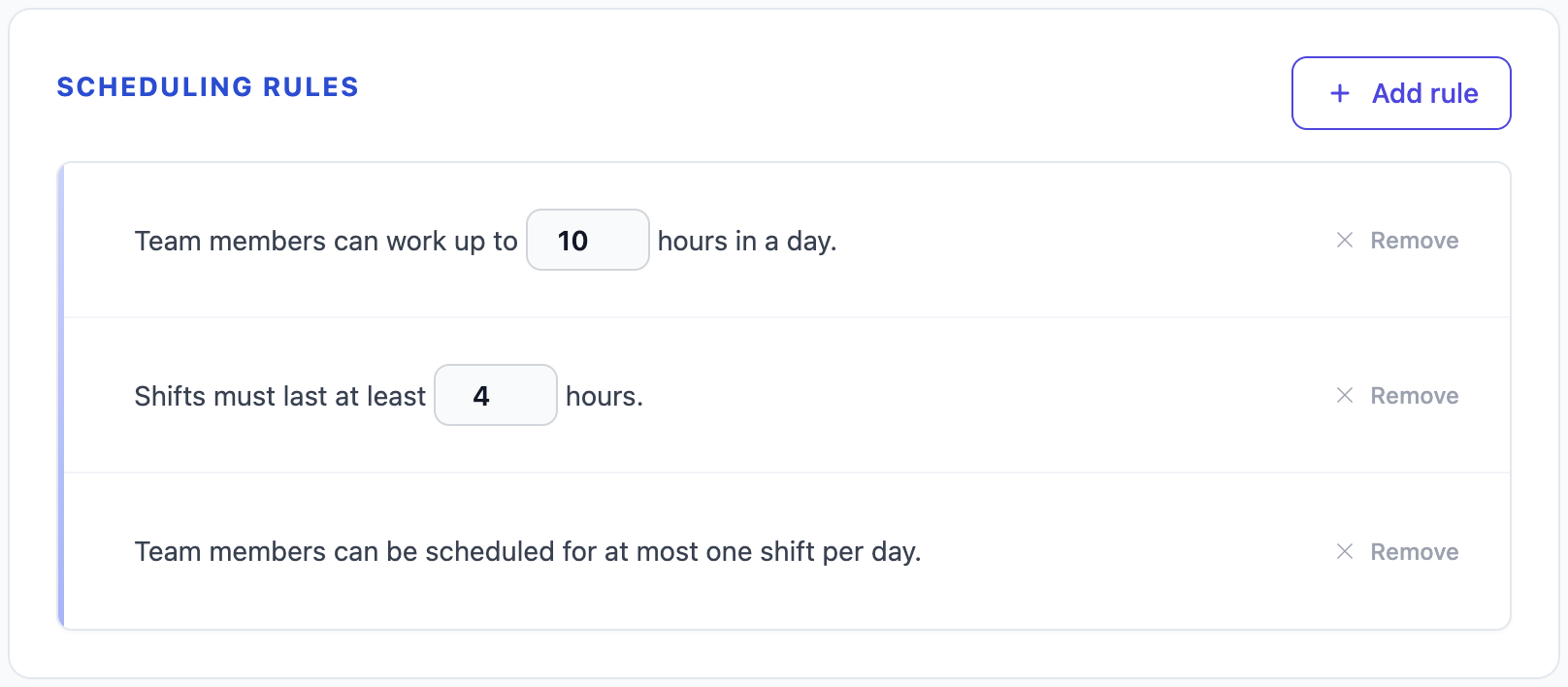
Instead of re-creating scheduling policies every month, you configure them once using SKEDA's library of constraint templates. For example:
- "Team members cannot work for longer than [6] consecutive days"
- "After a night shift, a team member must rest for [10] days"
- "Balance weekend shifts evenly across the team"
Each rule is a fill-in-the-blank sentence. No formulas, no conditional formatting—just your team's policies, saved and enforced automatically.
2. Generate a Schedule in Minutes
Once your rules are set, creating a new schedule takes just three steps:
- Review the staffing plan: Adjust for special events or changes in demand.
- Click Generate: SKEDA's solver engine finds an optimal assignment that satisfies every rule.
- Review and refine: Lock shifts you like, regenerate the rest, and publish.
The solver doesn't just find any schedule—it finds the best one. It respects hard constraints (coverage, rest periods, consecutive day limits) while optimizing for soft constraints (preferences, fairness, balance). If a team member requests time off, the solver treats it as a preference and works around it.
3. Refine Iteratively
Scheduling is never static. Someone calls in sick. A new hire joins mid-month. A shift swap is requested. SKEDA handles these changes effortlessly with pinned assignments: shifts you've already confirmed (or that have already happened) become fixed constraints. The solver then optimizes only the remaining open slots, allowing you to regenerate partial schedules without losing approved work.
This iterative approach ensures your workforce management stays agile and responsive.
The Impact of Automated Scheduling on Teams and Businesses
Switching from manual to constraint-based scheduling isn't just about saving time (though it often saves hours each week). It transforms team dynamics, improves compliance, and enhances productivity. Here's what changes when employee scheduling works as it should:
Fairness becomes measurable and provable. When an algorithm distributes weekend shifts, the rules are transparent, the distribution is trackable, and the system maintains a history of workload equity. This eliminates perceptions of favoritism and reduces turnover.
Employee preferences are prioritized. In manual shift planning, submitting preferences often feels futile. With automated scheduling, preferences become first-class inputs. While hard constraints (like coverage requirements) take priority, the solver optimizes for soft constraints (like time-off requests) whenever possible. Research confirms that personalized scheduling significantly improves work-life balance and job satisfaction.
Managers focus on leadership, not logistics. The hours saved from wrestling with spreadsheets are redirected to high-impact activities: supporting teams, improving processes, and—especially in healthcare—delivering better patient care.
Compliance is guaranteed, not an afterthought. Maximum hours, mandatory rest periods, and coverage requirements aren't retroactive checks—they're built into the solver from the start. If a valid schedule exists within your rules, SKEDA finds it. If not, the system flags conflicting constraints, so you can adjust proactively instead of reacting to gaps.
The result? Built-in compliance, happier teams, and smoother operations.
Getting Started Is Easy
The most common objection to scheduling software is setup effort. SKEDA is designed around a simple onboarding path:
- Add your team: enter names and roles, or feed the system a list of emails for quick invites
- Define your staffing requirements: how many people and which roles they need to have, for each hour of the week
- Set your rules: pick from the constraint library, fill in the blanks.
- Generate: click the button, review the result, publish to your team
Your team members see their shifts in the app, with automatic sync to Google Calendar. No bulletin boards, no group chat chaos, no Sunday afternoons lost to spreadsheets.
Why Staff Scheduling Deserves Better Tools
Employee scheduling impacts every aspect of an organization: burnout, retention, fairness, compliance, and the quality of service or care delivered. Yet most teams still rely on tools like spreadsheets, whiteboards, or shared documents—none of which were designed for the complexity of shift planning.
Constraint-based scheduling isn't new. Airlines, factories, and logistics companies have used it for decades to optimize operations. What is new is making this technology accessible to teams of any size—whether it's a 15-person pharmacy, a 30-person nursing unit, or a growing retail business—without enterprise contracts or consultants.
SKEDA brings automated scheduling to teams that need it most. With a fill-in-the-blank approach, it eliminates the inefficiencies of manual workforce management while ensuring fairness, compliance, and flexibility.
Your rules. Your team. One click.